Within the world of coffee, there are hundreds of varieties, each with its own agronomic and sensory characteristics. Some stand out for their productivity, others for their hardiness in cultivation, and a few have gained particular recognition for the quality of the cup they offer.
Among the latter are Maragogype, Pacas and Pacamara. Although each has its own distinct character, they share a close genetic relationship which explains many of their characteristics. Below, we look at their origins, their history and the traits that have made them highly prized varieties within the speciality coffee sector.
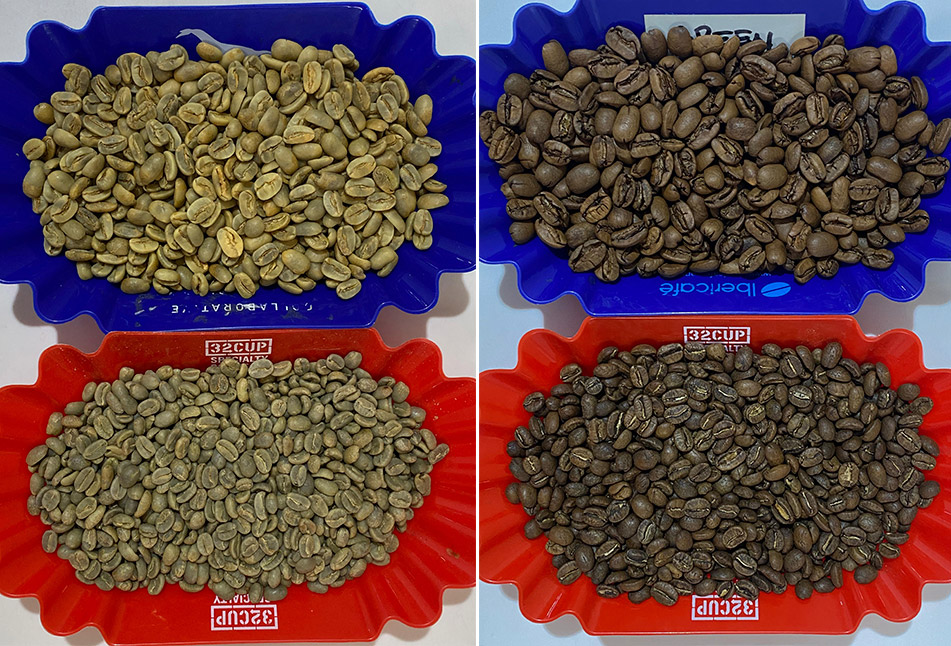
The photo above shows Maragojipe coffee beans. On the left, the green beans; on the right, the roasted beans.
Maragogype (mutation): the giant amongst coffee varieties
Maragogype is one of the most striking varieties in the world of coffee due to the extraordinary size of its beans. However, behind this uniqueness lies a history of genetic mutation, significant challenges in cultivation and a cup quality that continues to capture the interest of producers and roasters.
Genetic group
Bourbon-Típica group (Típica-related)
History
A spontaneous mutation of Typica was discovered near the Brazilian town of Maragogype in 1870. This is due to a single dominant gene which affects not only the size of the fruit (which is twice as large), but also the internodes and the size of the leaves. Consequently, due to the exceptionally large size of the beans, yield per coffee tree is very low, as is the planting density per hectare, which ranges from 3,000 to 4,000 trees. The first harvest is produced after four years.
A tall-growing plant, it adapts well to altitudes between 650 and 850 metres above sea level. It requires temperate temperatures and is sensitive to extreme weather conditions. It thrives in agroforestry systems that promote biodiversity and protect the plant from the wind. Consequently, this enormous yet extremely delicate plant requires coffee growers who are truly skilled in their craft and committed to the health of their coffee plantation.
Despite being highly prized by speciality roasters around the world, it is becoming increasingly difficult to find, as many coffee farmers have stopped growing it. The reasons for this lie in its lower productivity and high susceptibility to diseases such as rust, which requires constant monitoring. Furthermore, the tree’s large size makes management and pruning difficult and results in a slower and more costly harvest. Coffee growers must receive higher prices than for other varieties to compensate for all these difficulties.
Máximo Odón, who grows it on his La Venus estate in Nicaragua, notes that: “Maragogype is one of the finest and most iconic coffee varieties, but also one of the most demanding to cultivate. The pure Maragogype varieties that still survive today represent a valuable genetic heritage of coffee”.
Despite its size – or perhaps because of it – Maragogype produces light-bodied cups. Depending on the terroir, processing method and the coffee grower’s expertise, it offers profiles of chocolate, honey and caramel with subtle citrus notes. Whilst it is a challenging coffee for roasters, when it is of good quality, it is highly recommended for enjoying its subtle elegance in a filter brew or Italian coffee maker.
Whilst it was once grown in Mexico, Guatemala, Nicaragua, El Salvador, Colombia and Hawaii, it is now increasingly difficult to find and tends to be available only as very high-quality micro-lots for speciality roasters.
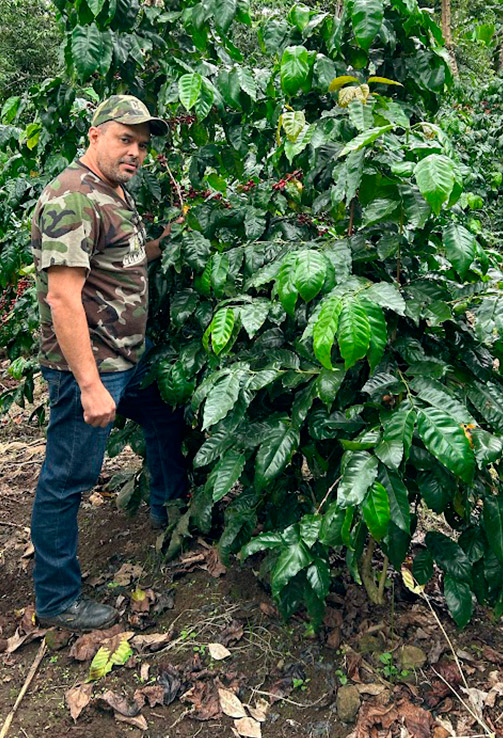
Máximo Odon, from Finca Venus in Nicaragua, standing in front of a Maragojipe plantation
Pacas (mutation): productivity and Salvadoran genetics
Discovered in El Salvador in the mid-20th century, Pacas is an example of how a natural mutation can improve a plantation’s productivity without compromising on quality. Furthermore, its significance extends far beyond its cultivation, as it gave rise to one of the most prestigious varieties of speciality coffee: Pacamara.
Genetic group
Bourbon-Típica group (Bourbon-related)
History
Pacas is a natural mutation of Bourbon, similar to Caturra in Brazil and Villa Sarchí in Costa Rica. Like other widely cultivated Bourbon mutants, Pacas has a single-gene mutation that causes the plant to become smaller (dwarfism). This is its main advantage: the plant’s small size leads to higher potential yields and the possibility of planting the trees closer together to increase the total fruit production on a farm. It produces its first harvest after 3 years, and between 5,000 and 6,000 coffee trees can be planted per hectare. It is susceptible to rust, and therefore requires preventive management and sufficient application of fertiliser.
The variety was discovered in 1949 on a farm owned by the Pacas family in the Santa Ana region of El Salvador. In 1960, the Salvadoran Institute for Coffee Research (ISIC) launched a pedigree selection programme (the selection of individual plants across successive generations) for Pacas. It is still widely grown in the country and accounts for around 25 per cent of the country’s coffee production. Seed stock is available from Procafe. It is also grown in Honduras, where it was introduced by IHCAFE in 1974.
Keita Matsumoto from the Osmanthus estate in Honduras, where it is grown, tells us: “It is an ideal variety because of its high yield and also because of the excellent quality of the coffee it produces, which offers floral aromas, bright acidity and a pleasant sweetness.”
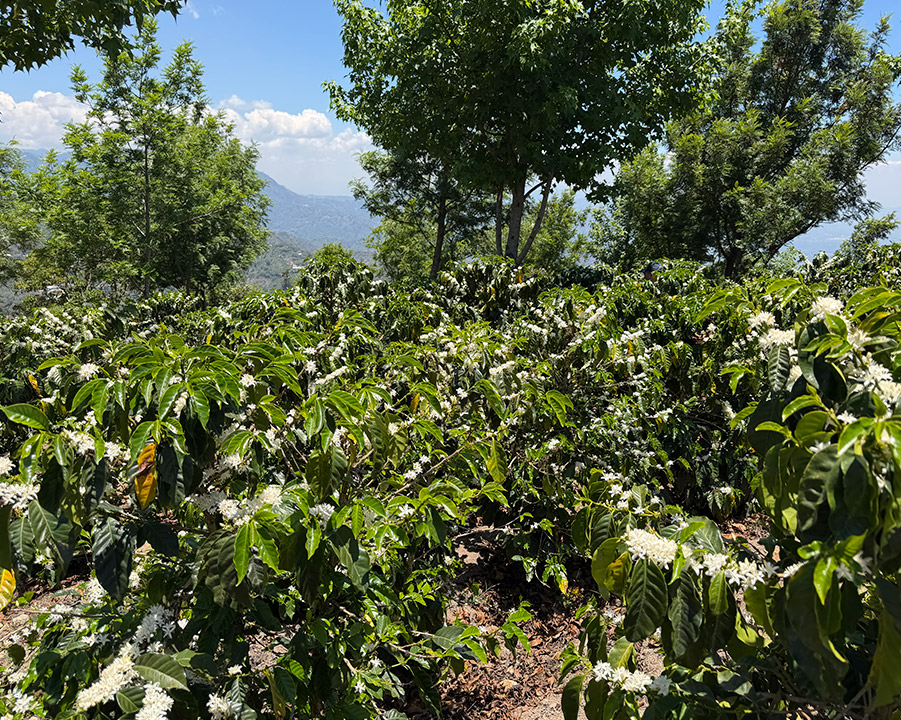
Pacas Plantation
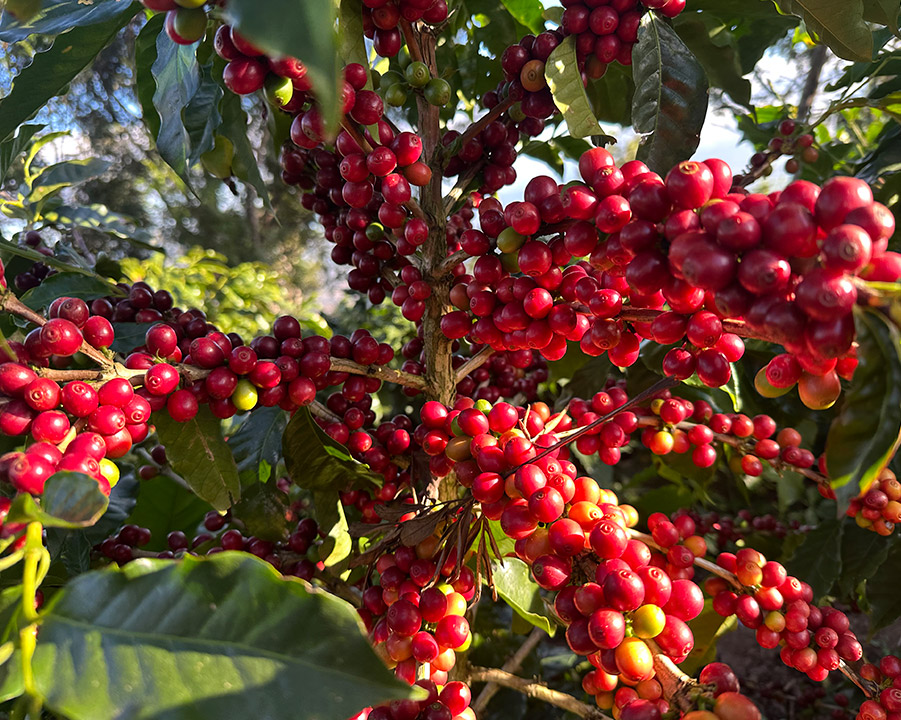
Bales of perfectly ripe coffee cherries
Pacamara (hybrid): a cross between Maragogype and Pacas
Pacamara is the result of combining the best qualities of Maragogype and Pacas. The result is a variety that has won over producers, roasters and judges at international competitions thanks to its extraordinary aromatic complexity and excellent cup potential.
Genetic group
Bourbon-Typica group (Bourbon and related Typica)
History
In 1958, the ISIC began work on the genetic improvement of coffee through hybridisation, using different varieties as parent plants. The resulting hybrids were analysed for their productivity characteristics and agronomic traits, with the cross between Pacas (a Bourbon mutation discovered in El Salvador) and Red Maragogype standing out in particular.
The best plants from the second generation of this cross were evaluated at the ISIC Experimental Station, resulting in nine lines which were subsequently studied over a further two generations. This particular cross aimed to combine the exceptional cup quality of Maragogype with the hardiness and higher yields of Pacas. It took around 30 years to isolate and stabilise the Pacamara, but it was finally released to growers in the late 1980s.
It is a vigorous, tall plant with dense foliage, short internodes and large leaves, which makes it wind-resistant and tolerant of drought, although it is highly susceptible to ‘Ojo de Gallo’ and rust. The cherries it produces are long and have a small protrusion, and the stones are large and oval-shaped. It can be grown at altitudes of between 1,200 and 2,000 metres above sea level. It yields its first harvest after three years; between 5,000 and 6,000 coffee trees can be planted per hectare, and its productivity is not particularly high.
Diego Baraona, a coffee farmer and owner of the renowned Los Pirineos estate in El Salvador, tells us: “What I like most is that it’s a very versatile variety when it comes to processing, as we’ve found that it produces a good cup whether washed, honey-processed or natural. These are different but very unique profiles, which achieve very good scores and complex flavour profiles. Los Pirineos was one of, if not the first, estates where this variety was planted, and thanks to this we have been able to develop a high-quality variety and a very stable genetic line over the last few decades.”
Pacamaras produce coffee of such excellent quality that they have won international cupping competitions. They typically offer complex and intense aromas; medium to full-bodied profiles with creamy textures; and an elegant acidity, with flavours ranging from sweet notes of chocolate and caramel to fruitier nuances that remind me of citrus, red berries and stone fruits.
Winners of numerous international coffee tasting competitions at Cafés El Magnífico, high-quality Pacamara beans are one of our favourite varieties due to their exceptional cup quality and the demanding challenge they present to us as roasters in bringing out all their aromas and flavours.
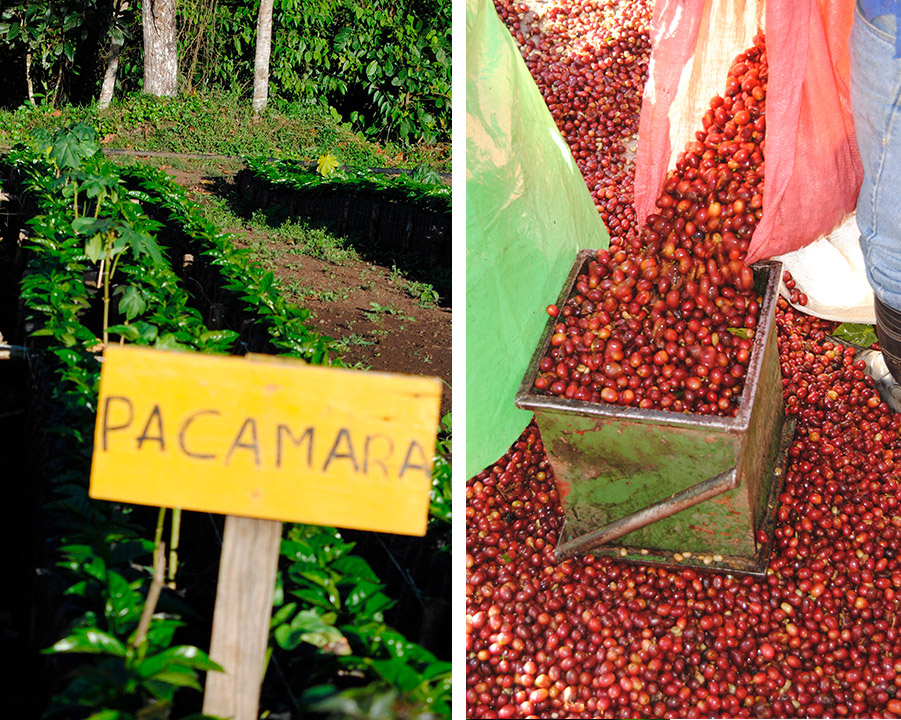
A Pacamara plantation and freshly harvested berries in Nicaragua
Maragogype, Pacas and Pacamara: three varieties that illustrate the richness of speciality coffee
Maragogype, Pacas and Pacamara are three varieties that reflect the genetic richness and diversity of speciality coffee. Understanding their origins, their agronomic characteristics and their flavour profile allows us to appreciate each coffee from a broader perspective and to understand the work that goes into every harvest.
At Cafés El Magnífico, we share this passion for learning about and sharing knowledge of coffee, convinced that understanding its history is also a way of better appreciating every cup.