At Cafés El Magnífico, our passion for speciality coffee also involves learning about the varieties that have shaped its history. Typica is one of them: a key lineage of Coffea arabica whose history helps us better understand the evolution of coffee cultivation and the relationship between genetics, origin and cup quality. Today we’re talking about Typica coffee.
Genetic description
Typica is one of the fundamental lineages of Coffea arabica, alongside Bourbon, and one of the varieties that has had the greatest influence on the history of cultivated coffee. Its origins lie in the Coffea arabica populations of Ethiopia, from where coffee reached Yemen and subsequently spread to Asia, the Caribbean and the Americas.
The Typica group forms part of the so-called Bourbon-Typica group and constitutes the genetic basis for numerous populations and varieties of Coffea arabica currently under cultivation. Its historical importance is due not only to its age, but also to the role it played in the global expansion of coffee cultivation.
Throughout the 18th and 19th centuries, Typica spread from Java and the European colonies to the Caribbean, Central America and South America. For much of the modern history of coffee, particularly up until the mid-20th century, it was one of the main varieties cultivated in the Americas.
Typica is recognised primarily for its potential to produce a high-quality cup. Compared to varieties selected for their productivity or resistance, it has a relatively low yield and is highly susceptible to disease. However, when grown under suitable conditions, it can produce a clean, sweet, balanced and complex cup.
The History and Spread of Typica Coffee
The history of Typica is closely linked to the spread of coffee from its regions of origin to the world’s main coffee-producing areas. Its journey provides insight into much of the historical development of coffee cultivation.
From Ethiopia and Yemen to Java and Europe
Although the distant origins of Typica lie in the Coffea arabica populations of Ethiopia, its development as a distinct variety is closely linked to Yemen and the subsequent spread of coffee via European trade routes.
During the 15th and 16th centuries, coffee was brought from Ethiopia to Yemen, where the first major traditions of cultivating and selecting Coffea arabica were established. Subsequently, seeds from Yemen reached India and, towards the end of the 17th century, were transported from the Malabar Coast to Batavia – now Jakarta – on Java.
The plants established in Java gave rise to a population that would later become known as Typica. In 1706, a coffee plant from Java was taken to Amsterdam and cultivated in the city’s botanical gardens. From this source, the variety spread further across Europe and the Dutch colonies.
The spread of Typica across the Americas
In 1714, a plant was sent from Amsterdam to France. From the Netherlands, coffee was subsequently introduced into Dutch Guiana – now Suriname – and from there it reached Cayenne and northern Brazil. At the same time, plants sent from France reached Martinique in 1723, from where Typica continued its spread throughout the Caribbean.
Over the following decades, the variety reached Jamaica, Santo Domingo and Cuba, and subsequently spread to other coffee-producing regions in Central and South America. From Cuba, it was introduced into Costa Rica and El Salvador, whilst other movements of seeds and plants contributed to its establishment in various countries across the region.
This network of exchanges led to Typica becoming one of the most important genetic foundations of coffee cultivation in the Americas. Until around the 1940s, a very significant proportion of commercial plantations in Central and South America consisted of Typica.
The decline in its cultivation and its current status
Its low productivity and high susceptibility to disease, particularly coffee rust, subsequently led to it being replaced by more productive and resistant varieties. However, Typica continues to have a significant presence in countries such as Peru, Panama, the Dominican Republic and Jamaica. In Jamaica, one of its best-known varieties is associated with the production of Jamaica Blue Mountain.
Characteristics of the Typica coffee plant
La variedad Typica presenta una serie de rasgos morfológicos que la distinguen de otros cultivares de Coffea arabica. Su porte, la disposición de las ramas y las características de sus hojas y cerezas influyen tanto en su aspecto como en las necesidades de manejo del cultivo. Conocer estos elementos ayuda a entender mejor su comportamiento agronómico.
Growth habit, branches and architecture of the coffee tree
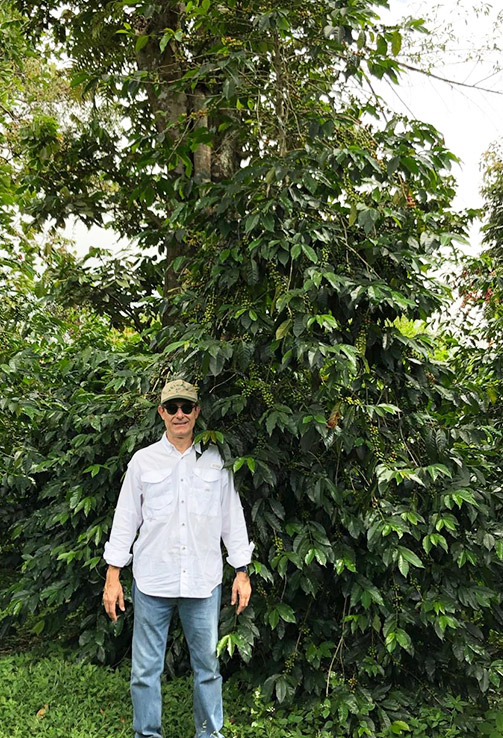
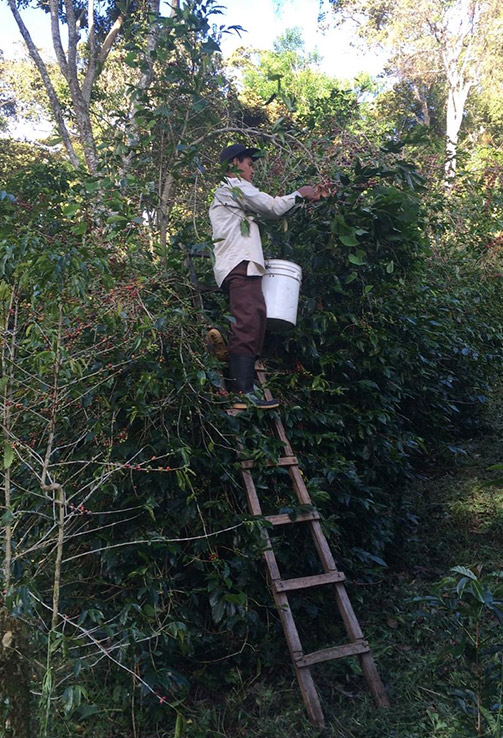
Typica is a tall plant with an open architecture and a generally conical shape. It has a vertical main stem and relatively long lateral branches, with wide internodes (which facilitate harvesting). Furthermore, it has a lower branching density than many modern compact cultivars.
José Antonio Ramírez from the Las Playitas estate in Comayaguas, Honduras, tells us that “as the branches are very long, when they are heavily laden they break and fall to the ground. To prevent this, we ‘hook’ branches from two neighbouring coffee trees together”.
Leaves, cherries and bean size
The leaves are generally large, elliptical and dark green, with a glossy surface and slightly wavy margins. In many Typica lines, young leaves display bronze or reddish hues before taking on their final green colour.
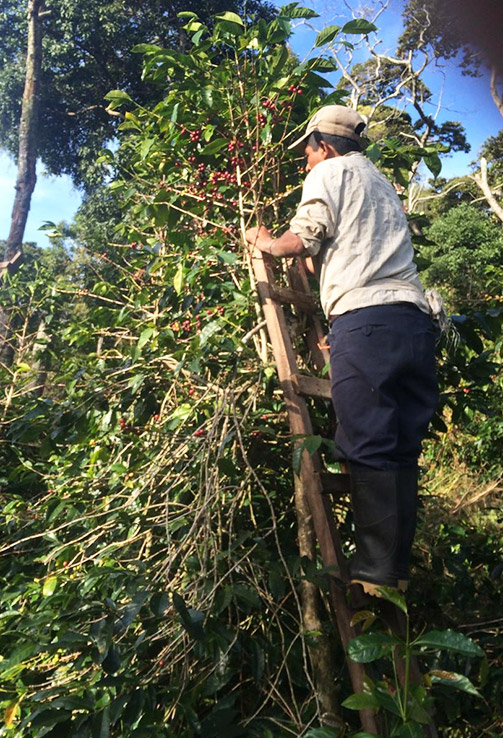
Ripe cherries have yellow, orange or red hues depending on the genetic line and growing conditions; they are usually relatively elongated and contain good-sized beans.
Implications of plant height for cultivation
The plant can grow to several metres in height if not controlled by pruning. In commercial systems, it is usually kept at a height that facilitates management and harvesting.
Its tall growth habit has significant agronomic implications. It requires greater spacing between plants than compact cultivars so that “the coffee trees do not shade one another and result in lower yields”, explains José Antonio.
Yield and susceptibility to diseases
One of the main agronomic characteristics of Typica is its relatively low productivity. Under identical conditions, it tends to produce less than varieties specifically selected to maximise yield.
This lower productivity is accompanied by a high susceptibility to various plant health problems. Typica is susceptible to coffee rust and other diseases and pests affecting Coffea arabica, meaning that its cultivation may require more careful agronomic management.
It is sensitive to extreme environmental conditions.
For these reasons, Typica is generally better suited to cultivation systems where climatic conditions are relatively stable and there is good management of shade, water, soil and nutrition.
Altitude, climate and growing conditions
Typica thrives particularly well in tropical and subtropical mountainous regions. That said, the optimum altitude depends on the latitude, the local climate and the characteristics of each estate. Generally speaking, it can be found at altitudes ranging from approximately 900 to 2,000 metres above sea level, with higher elevations in certain equatorial areas.
Moderate temperatures favour its growth and the quality of the fruit. Excessively high and prolonged temperatures can increase stress on the plant and affect flowering, fruit development and the final quality.
An annual rainfall of approximately 1,200 to 2,000 mm can provide good conditions for growth, provided it is reasonably evenly distributed throughout the year. A relatively short dry spell can help to synchronise flowering, whilst excessive moisture and prolonged waterlogging can cause root problems and increase the risk of disease.
Soil
The best results are usually obtained in deep, fertile and well-drained soils with a good organic matter content. Soils of volcanic origin can offer particularly favourable conditions due to their structure, nutrient-holding capacity and biological activity.
Well-drained loamy soils, deep soils of forest origin and certain structured red clays may be suitable provided they allow good root penetration.
Shade and agroforestry management
Typica can benefit from cultivation systems with moderate shade, particularly in areas where temperatures, solar radiation or water deficit may cause stress.
Well-managed shade can help moderate temperature, reduce evapotranspiration, protect plants from the wind and promote a more gradual ripening of the cherries.
The banana is one of the most common companion crops in coffee systems. Its relatively rapid growth provides temporary shade and protection from the wind. It also produces a significant amount of biomass that can be incorporated into the soil as organic matter. Finally, it provides a supplementary source of income for the farm.
Cup quality of Typica coffee
Beyond its genetic and agronomic characteristics, Typica stands out for its potential to produce high-quality coffees. Its sensory profile can vary depending on growing conditions and post-harvest processing, resulting in a range of different profiles.
Therefore, to understand its appeal in the world of speciality coffee, it is worth examining both its attributes in the cup and the factors that determine them.
Sensory profile: sweetness, acidity and complexity
The main reason why Typica continues to be highly regarded, despite its agronomic limitations, is its potential for quality.
When grown under suitable conditions and harvested and processed correctly, it can produce a clean, elegant and balanced cup, characterised by distinct acidity, sweetness and a delicate structure.
Its sensory profile may feature floral, fruity, sweet, cocoa or nutty notes. However, these characteristics depend largely on the origin, altitude, microclimate, the ripeness of the cherry and the processing method used.
The influence of origin and terroir
One of the most interesting features of Typica is its ability to clearly express the characteristics of the place where it is grown. Therefore, rather than associating it with a single flavour profile, it is more appropriate to consider it a variety with a high potential for expressing the terroir.
The final result can vary considerably between regions and estates. Genetics provide a foundation, but factors such as altitude, soil, climate, shade, nutrition, cherry selection and processing have a decisive influence on the cup.
The current significance of the Typica variety
Typica occupies a pivotal place in the history of Coffea arabica. Its significance extends beyond its current presence on commercial plantations: it represents one of the major lineages from which much of the world’s coffee cultivation has developed.
Its spread from Ethiopia and Yemen to Asia, the Caribbean and Latin America paralleled the international expansion of coffee itself as an agricultural and commercial product. Many populations and cultivated materials in different regions retain a direct or historical genetic link to Typica.
Today, the variety remains of particular interest to quality-oriented producers, for the conservation of traditional genetic material, and for certain regions where its historical adaptation and cupping potential justify lower yields.
Ultimately, Typica represents a unique balance between history, genetics and quality. It is a less productive and more vulnerable variety than many modern cultivars. However, its architecture, its adaptation to certain mountainous environments and, above all, its ability to produce elegant and expressive coffees explain why it continues to occupy a prominent place within the culture of speciality coffee.
Learning about varieties such as Typica helps us to better understand the diversity of speciality coffee and everything that goes into every cup. At Cafés El Magnífico, this knowledge is part of the way we approach coffee: with a curiosity about its origins, respect for the work of the producers, and an eye for the nuances that make each coffee unique.