In the world of speciality coffee, knowing the origin and genetics of each cultivar helps us to better understand the diversity we find in the cup. Here at Cafés El Magnífico, we take a closer look at two key names in Latin American coffee cultivation: Caturra and Catuaí.
Catuaí Coffee
Catuaí holds a prominent place in the history of coffee cultivation in Brazil and Central America. Its development stems from the search for productive, compact plants, but learning about it also allows us to discover the story behind its evolution and the distinctive characteristics it can offer in the cup.
Origin and development of the Catuaí variety
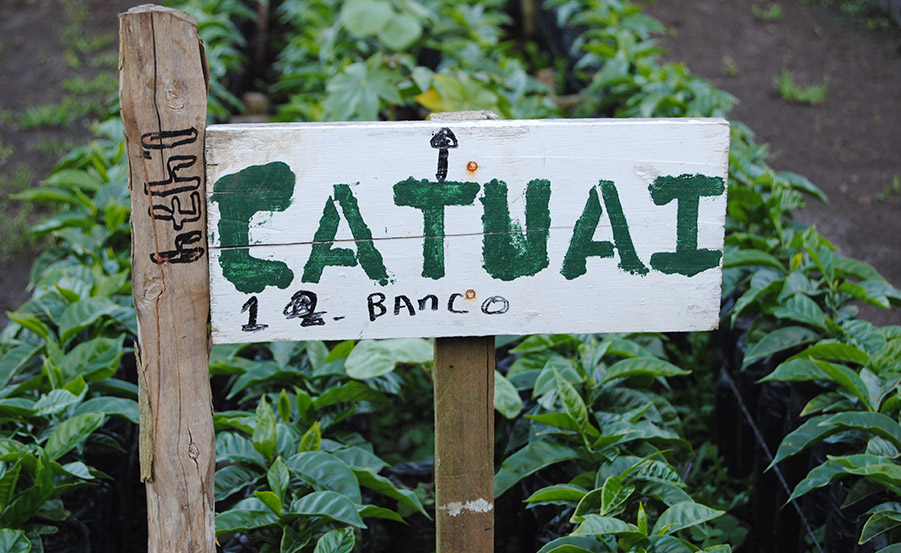
The Catuaí coffee cultivar is one of the most successful in Brazilian agriculture. It was developed by Dr Alcides Carvalho (1913–1993), a researcher at the Campinas Agronomic Institute (IAC). He achieved this by crossing ‘Caturra’ and ‘Mundo Novo’ in 1949, with the aim of combining vigorous growth with a compact plant size.
The IAC set out to report on the activities that culminated in the recommendation of 16 ‘Catuaí’ lines – comprising eight lines with red fruit and eight with yellow fruit – by analysing data from various experiments. The decision on which lines to recommend was made in the F1:2 generation, based on two harvests.
Its original name was H-2077. The variety was launched in Brazil in 1972 following pedigree selection (the selection of individual plants across successive generations) and is widely cultivated there. In Brazil, there are numerous Catuaí lines available, some of which are notable for their high productivity. The Catuaí lines introduced to Central America appear to be less productive. Studies in Honduras and Costa Rica found no significant differences in productivity between Caturra and Catuaí.
It was first introduced to Honduras in 1979, where it was tested by the Honduran Coffee Institute (IHCAFÉ) and commercially launched in 1983, after IHCAFÉ had selected two lines for planting.
Characteristics of the Catuaí coffee plant and its cultivation
The Catuaí’s small stature allows it to be planted densely (5,000–6,000 trees per hectare, using the single vertical stem pruning method) and harvested more efficiently. These factors contributed in part to the intensification of full-sun coffee cultivation in Central America in the 1970s and 1980s. It is a very vigorous, low-growing variety that develops a great deal of lateral growth.
Cup profile of Catuaí coffee
At its best, Catuaí develops notes of chocolate, caramel, honey and ripe stone fruit on the palate, with a smooth body ranging from medium to full and a gentle acidity. It has density — weight on the palate — and it is this quality that makes it so versatile.
How altitude affects Catuaí coffee
In Panama, the Catuaí coffee variety grows with optimal yields at altitudes between 1,200 and 1,800 metres above sea level. The higher the altitude (reaching up to 1,900 or 2,000 metres above sea level on specialised farms in regions such as Boquete or Volcán), the more complex the flavour profile of the cup becomes. This results in a brighter acidity, citrus and floral notes, and sweet chocolate undertones.
Alcides Carvalho, a key figure in Brazilian coffee genetics
The development of cultivars such as Caturra and Catuaí is closely linked to the work of researchers who dedicated their careers to improving coffee plants. Among them, Alcides Carvalho plays a pivotal role due to his contributions to coffee genetics and the transformation of Brazilian coffee cultivation.
The scientific legacy of Alcides Carvalho
Alcides Carvalho was a distinguished Brazilian agronomist and geneticist, recognised worldwide as the father of modern coffee cultivation in Brazil. He is also renowned for his extraordinary work in coffee breeding at the Campinas Agronomic Institute.
During his professional career, he developed more than 60 different varieties of this plant. Dr Carvalho remains a great example to all plant breeders today, thanks to his scientific rigour and his belief that coffee farmers can be great allies to scientists.
His scientific legacy remains the cornerstone upon which the high productivity and international recognition of Brazilian coffee rest today, including the Caturra and Catuaí varieties.
Key contributions to the coffee industry
- Creation of famous varieties. He was directly responsible for the cross-breeding carried out in 1949 that gave rise to the Catuaí variety. It is one of the most successful and widespread crops in Brazilian and Latin American agriculture.
- Naturally decaffeinated coffee. Mutations of the Coffea arabica species – AC1, AC2 and AC3 – were named in his honour; these are notable for containing extremely low levels of caffeine completely naturally, without compromising the quality of the brew.
- Yield improvement. His research has succeeded in combining the vigour of the plants with a smaller size, drastically facilitating harvesting and optimising space on coffee plantations.
Cafè Caturra
Caturra is another of the cultivars that have left a significant mark on Latin American coffee cultivation. Its history combines a natural mutation with decades of selection and adaptation, a journey that helps us to understand both its spread and the demands of its cultivation.
Origen y expansión del café Caturra
Caturra is a natural mutation of the Bourbon variety. It was discovered on a plantation in the state of Minas Gerais in Brazil sometime between 1915 and 1918. Caturra has a single-gene mutation that causes the plant to become smaller (dwarfism), which is why it was named after the Guaraní word meaning ‘small’.
Following its discovery, selection work was carried out by the Agronomic Institute (IAC) of the State of São Paulo from 1937 onwards. Breeders were interested in Caturra’s small size, which allows the plants to be spaced more closely together, and its secondary branches, which are very close to one another, thereby enabling more fruit to be produced in the same space.
The selection process for Caturra was known as mass selection. This involves selecting a group of plants based on their superior yield; the seeds from these plants are collected to form a new generation, and the process is then repeated.
The variety was never officially introduced in Brazil, but it has become common in Central America. It was introduced into Guatemala in the 1940s, but widespread commercial adoption did not occur until three decades later.
It was introduced from Guatemala to Costa Rica, Honduras and Panama. For decades, it was one of the most economically important coffees in Central America, in that it was often used (and is sometimes still used) as a ‘benchmark’ against which new cultivars are tested.
In Colombia, for example, it came to account for almost half of the country’s production until a government-sponsored programme launched in 2008 encouraged the replacement of more than three billion coffee trees with the rust-resistant Castillo variety (which is of Caturra descent). Caturra contributed in part to the intensification of coffee cultivation through higher-density planting, often in full sun, during the second half of the century.
Altitude and ideal growing conditions for Caturra
Its ideal terroir is characterised by nutrient-rich volcanic soils, high altitudes and consistent rainfall. All these factors are key to developing its distinctive cup profile, with bright citrus acidity and a clean sweetness.
The general growing range for achieving the highest quality is between 1,000 and 2,000 metres above sea level (masl). Caturra’s quality potential increases with altitude, as the cold slows down the ripening of the bean, concentrating sugars and acidity, although yield per plant decreases.
Soil and nutritional requirements of the Caturra coffee plant
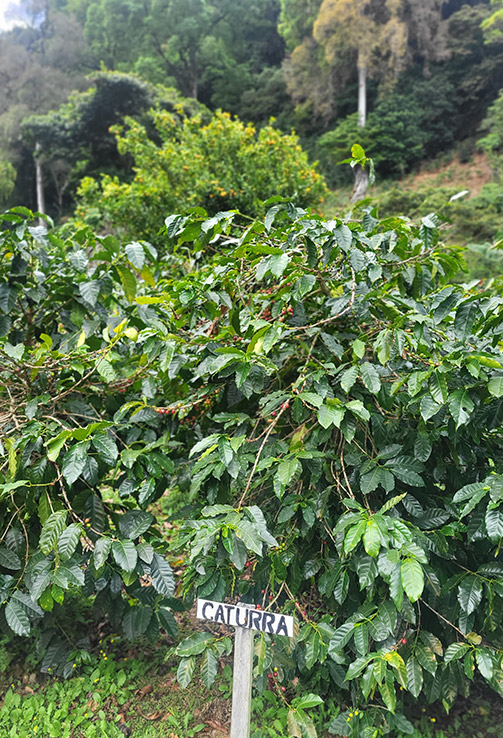
Caturra is a demanding plant that requires rigorous agronomic management and soil in optimal condition:
- Soil type. It prefers deep, volcanic soils – loam or silty loam – which have excellent drainage and a high concentration of organic matter.
- Nutrition. Unlike other, more hardy varieties, Caturra requires high levels of fertilisation. As it is a low-growing plant with very short internodes, it produces a large amount of fruit in a small space. If the soil is not intensively fertilised, the plant suffers from ‘exhaustion’, losing foliage and drastically reducing its lifespan.
Climate, rainfall and planting density
To achieve the perfect balance in its terroir, Caturra requires a stable climate with well-distributed annual rainfall of between 1,500 and 3,500 mm. It is a variety that can be grown in full sun, allowing for high planting densities (between 5,000 and 6,000 trees per hectare). However, at lower altitudes or in very hot climates, the use of moderate shade helps to protect the plant and regulate the temperature.
Coffee’s diversity begins with the plant
As you’ve seen with this Caturra and Catuaí, there’s much more to every coffee than just its origin or brewing method. The plant’s genetics, its adaptation to its environment and the decisions made by those who grow it are also part of its identity. At Cafés El Magnífico, we’re keen to explore that diversity and share the knowledge that helps us discover new nuances in the world of speciality coffee. And today we’ve done just that with this Caturra and Catuaí.