At Cafés El Magnífico, we know that an excellent coffee is the result of the interplay between nature (terroir and variety) and human labour, knowledge and determination. The genetics of the variety, cultivar, hybrid or mutation play a significant role in the aroma and flavour potential of a cup of coffee, which is why we mention this in the information sheet included in our bags.
With the help of the coffee farmers who grow them, we’ll get to know these plants, understand the potential quality of their beans and the challenges they face in the field.
In this article, we take a closer look at Wush Wush coffee, a variety of Coffea arabica with great aromatic and flavour expression, to discover its origin, its characteristics and how its potential unfolds in the cup.
Wush Wush: la exuberancia aromática
Ethiopia is the place of origin and diversity of Coffea arabica (1), widely recognised for the quality and variety of its sensory profiles. Researchers estimate that Ethiopia is home to thousands of distinct coffee genotypes (2), the vast majority of which remain uncategorised; until geneticists classify them, they are grouped under the label ‘Ethiopian heirloom’.
Ethiopia’s wild and cultivated coffee populations possess genetic traits of disease resistance, climate adaptation and flavour complexity that breeders worldwide need to develop new, resilient varieties. As climate change threatens global coffee production, Ethiopia’s genetic resources are essential for the long-term survival of Arabica coffee.
Consequently, due to the genetic bottleneck threatening the species, Ethiopian coffee seeds were sent to germplasm collections for study, breeding, the creation of new hybrids, or to be propagated and planted in other environments to study their behaviour.
One such example is the fascinating Geisha (3), but there are others. Wush Wush is another example, as are Sidra, Papayo, Borbón Rosado and Ombligón. All of these coffees possess a strong flavour and aroma profile.
The origins of Wush Wush in Ethiopia
“Kaffa is a famous coffee-growing region, known as the birthplace of coffee. To the west, it stretches through the villages of Wushwush, Dara and Dimbira, ending around Wacha. To the east, the Kaffa coffee-growing region extends as far as the town of Shebe. It also covers a vast area to the north and south of Bonga, bordering the Jimma-Limu coffee-growing region to the north-west and those of Bench Maji and Tepi to the west”. (3)
These areas contain a vast reserve of natural genetic resources of both wild and semi-wild coffee plants. They are places where coffee trees grow at high altitudes in very humid conditions, where the pressure from coffee berry disease (CBD) is very high, causing significant damage to crops.
To tackle this problem, in 1975 the Jimma Agricultural Research Centre selected four varieties characterised by their high productivity, resistance to CBD and superior cup quality, reflecting the flavour profile of the region (wine-like, with bright acidity, floral notes and a pronounced sweetness), which had been propagated by local coffee farmers using traditional knowledge.
Among these was one from which 25 coffee trees were selected in Wushwush, in the Gimbo woreda*, in the Keffa region. Of these, only one selection, number 754, was approved for release as part of the group of CBD-resistant plants in 1981. The variety was released in 2006 for cultivation in the coffee-growing areas of Gera and Wush Wush at altitudes between 1,750 and 2,100 metres above sea level. The variety takes its name from the original location of the selection.” (4)
Where is Wush Wush coffee grown?
Today, as well as in Ethiopia, Wush Wush can be found in Colombia and Panama, where the high altitude and fertile growing conditions – similar to those of its place of origin – favour the fruity, delicate and floral cup profiles that consumers expect and value in these sought-after varieties.
At the start of this century, Wush Wush began to be planted on pioneering farms in Colombia thanks to seeds from the nurseries of Cenicafé, the Colombian coffee research institute, which brought Wush Wush directly from Ethiopia for its collection of coffee plants for research purposes. In Colombia, the genetic resources of Coffea arabica are conserved in the Colombian Coffee Collection (CCC), which supports Cenicafé’s plant breeding programme.
Wush Wush on the coffee plantation
In Panama, where there is a group of highly experienced coffee growers and innovation in high-quality coffee farming is the norm, Wush Wush was introduced a few years ago with the aim of continuing to offer coffees with stunning cup profiles that are distinct from those of its legendary Geisha.
Characteristics of the Wush Wush plant
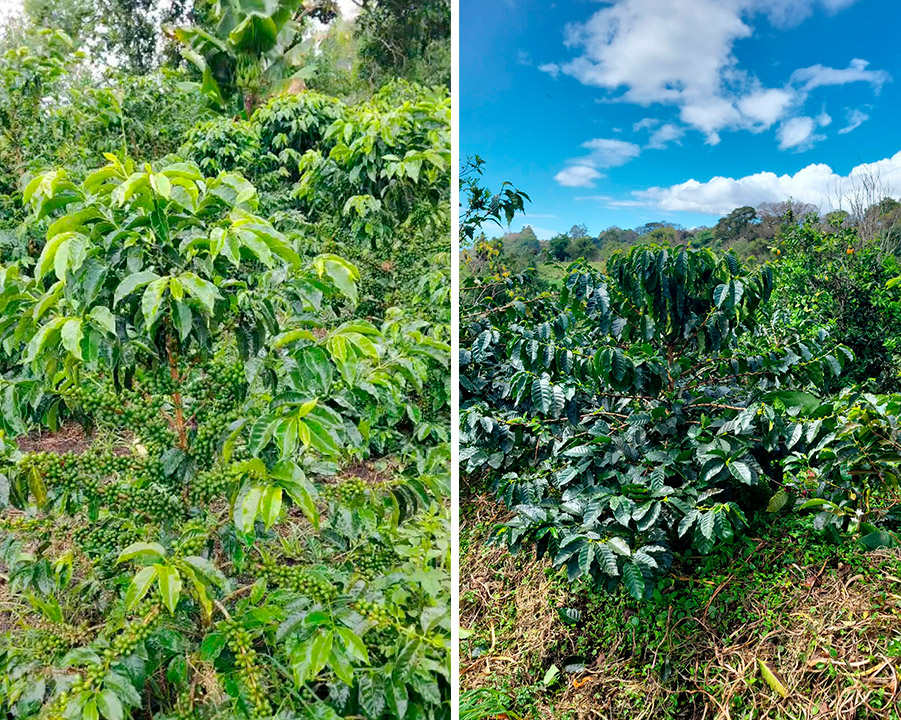
We asked Yessie Hartmann, a member of the renowned Hartmann family and a coffee grower herself, to tell us about the cultivation of Wush Wush in Panama. Yessie tells us that “the Wush Wush variety has a medium to tall growth habit. In high-altitude areas, the plant can easily exceed one metre seventy centimetres in height, developing a vigorous growth habit. Its leaves are medium-sized, elongated and slightly broad, characteristics that make it easy to identify in the field.
Its yield potential ranges from medium to high, depending on agronomic management, nutrition and environmental conditions. During the ripening process, the fruit gradually changes from an orange hue to a deep red with shades similar to those of a grape, which is the optimal time for harvesting.
Due to the staggered ripening of the fruit, this variety requires highly selective harvesting, involving between six and seven passes – or even more – with the aim of picking only cherries at their optimum stage of ripeness and ensuring the highest quality coffee.
The cultivation of Wush Wush in Panama
In Panama, it has exhibited a morphological expression distinct from that observed in its place of origin. Under our agroecological conditions, it develops into a more robust, vigorous plant with remarkable vegetative vitality, resulting from the interaction between the genetic material and the environment.
Its agronomic management is demanding and requires constant monitoring. Due to its high energy and nutrient consumption during the various phenological stages, field tasks such as fertilisation, phytosanitary monitoring, pest control and general maintenance are carried out approximately every 22 to 30 days, depending on weather conditions and the physiological state of the crop.
Plant selection and genetic expression
It is important to bear in mind that the expression of a variety can vary due to a number of factors. For this reason, during plant production in the nursery, a two-stage selection process is carried out in the seedbed, with the aim of retaining only those seedlings that express the desired characteristics and ensuring that, upon reaching their productive stage at approximately four years, the plants maintain high agronomic and productive potential.
When different coffee varieties are present on the same estate or in neighbouring areas, pollination by bees and other insects can promote genetic recombination in the seeds, giving rise to plants with different phenotypic expressions. These variations can manifest themselves in characteristics such as vigour, plant architecture, productivity and the expression of sensory attributes in the cup. Furthermore, factors such as agronomic management, nutrition, altitude, climate and soil conditions play a decisive role in the plant’s development and in the expression of its productive and quality potential.”
Wush Wush in your cup
An article on this variety in Forum Café magazine emphasises that “the tasting notes of roasted Wush Wush coffee are clear evidence of this coffee’s complexity and unique flavour profile, although it is difficult to define a single profile for it. The reason is that Wush Wush is thought to comprise up to 20 different genotypes, which develop differently depending on growing conditions, thus offering noticeably different flavour profiles.
In fact, the Wush Wush coffee plant’s ability to adapt to its environment and change is the reason why coffee farmers must meticulously select ‘genuine’ coffee trees every time they wish to replant this Ethiopian variety of Arabica coffee.”
The sensory profile according to the type of processed producto
Washed Wush Wush
A washed Wush Wush has an intense, fragrant aroma with hints of jasmine, rose, bergamot, hibiscus and vanilla. The body is silky. The lively acidity lends it a juicy note and, together with a distinct sweetness, enhances the drink’s complexity. The flavour features notes of tropical fruit, lychee and grapefruit. The finish is smooth, leaving a lingering hint of sweet spices and panela.
Wush Wush – Natural Process
When Wush Wush cherries are processed using the natural method – and provided this is done correctly – the beans develop an intensely floral aroma with notes of tropical fruit such as mango and passion fruit, sweet citrus fruits such as orange, grape, honey or sugar candy. On the palate, it has a syrupy body with a lively acidity that gives it a juicy, sweet sensation, and may develop notes of ripe red berries, tropical fruit, cocoa nibs and spices.
The complexity of this varietal’s aromas and flavours is magnificent, and we’re sure you’ll discover fascinating flavour notes beyond those in this guide.
(1) Historia del café arábica y su expansión por el mundo, Salvador Sans, blog Cafés El Magnífico
(2) Términos del café: Taxonomía, Salvador Sans, blog Cafés El Magnífico
(3) Coffee Atlas of Ethiopia, Aaron Davis et ali. Royal Botanic Gardens, 2018
(4) A Reference Guide to Ethiopian Coffee Varieties, Getu Bekele and Timothy Hil
Another recommended read: Jeff Koelher, Where the Wild Coffee Grows: The Untold Story of Coffee from the Cloud Forests of Ethiopia to Your Cup
*Woreda: They are generally sub-divisions of areas, and each has its own elected council.