Destination Panamá
In March, we travelled to Panama to experience first-hand one of the world’s most unique coffee-growing regions.
It was my father’s fourth visit to the country. For me, too, it was the first coffee-growing country I’d had the chance to visit, which made this trip particularly eagerly anticipated. For the first time, I was able to visit the farms and meet the producers directly, and to discover the origins of some of the coffees and coffee growers we admire so much.
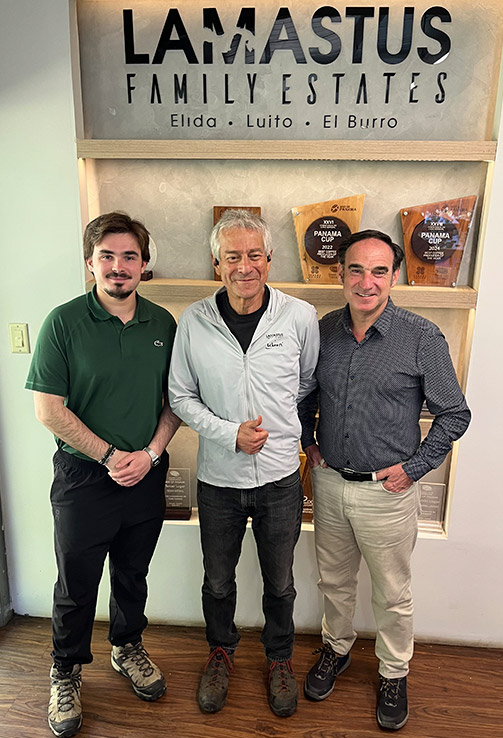
Nine estates and over 210 coffees
During the trip, we visited around nine estates and tasted over 210 coffees of different varieties, processing methods and flavour profiles. But the true value of the trip lay far beyond the tastings: in touring the estates, talking to the producers and learning first-hand the stories behind each Panama coffee.
We were accompanied by Ushi Zimmermann, a coffee importer in Austria and an expert on the Panama coffee sector, with whom we have been working for many years. Her close relationship with the country’s producers opened the doors to some of their most prestigious estates for us.
Farm after farm, we were able to walk amongst the coffee trees, observe the differences between trees of different varieties and understand how each variety adapts to a specific environment. We also learnt about the decisions each producer makes, their working methods, the processes they employ and the way in which each one understands their own farm.
Beyond the cup: discovering the origin
Every visit had a different story. Families who have been growing coffee for generations, producers who have dedicated their entire lives to those lands, and new generations experimenting with varieties and processes to continue developing the potential of their estates.
Being able to taste the coffees from an estate after walking through the coffee plantation and talking to the person who grows them allows you to understand the passion of those who love good coffee. A variety ceases to be merely a name; a process ceases to be just a technique; and a cup comes to represent a region, a family, a story and many hours of labour.
Panama allowed me to approach coffee from its true source: from the farm, from the tree and, above all, from the people who make it possible.
We took away much more than just the memory of the coffees we tasted. We took away names, stories, lessons learnt and a new way of understanding everything that goes into every harvest. Because once you get to know the place, the land and the people behind a coffee, it’s impossible to look at it in the same way again.
Sharing my first trip to a coffee-growing country with my father is an unforgettable memory that we will both carry with us forever.
11 Panamanian cafés to discover at El Magnífico
Here at Cafés El Magnífico, we’re bringing you a selection of 11 coffees from Panama, chosen from the tasting tables at Elida, Mi Finquita, Carmen Estate, Cafetalera Fernández, Alttieri, Hartmann, Bonita Springs and Mil Cumbres. The coming months will be dedicated to Panamanian coffee farming. We’ll announce the roasting dates and availability for each one.
We hope you enjoy every sip of the coffees you take home and that, in some way, their aroma and flavour transport you to the beautiful highlands of Panama.
Salvador Sans i Witty
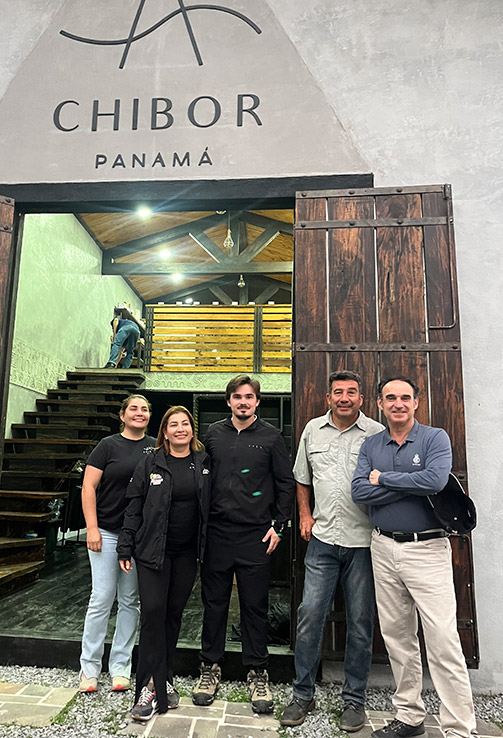
Panama: a small producer with a huge influence
Panama does not compete on volume. It competes on identity, precision and excellence.
Although it accounts for just 0.1 per cent of the global coffee supply, Panama exerts a huge influence on the speciality coffee market. Its significance does not stem from volume, but from its ability to take quality, value and experimentation to new heights.
Over recent decades, Panama has helped to redefine perceptions of high-end coffee: from the international recognition of the Geisha variety to experimentation with new processing techniques, via a production model based on small estates, microclimates and extraordinary attention to detail.
Geisha and the transformation of Panama coffee
Panama is now the leading international producer of the Geisha — or Gesha — variety, which originates from Ethiopia and thrives particularly well in the highlands of Chiriquí, in regions such as Boquete and Volcán.
In the cup, the finest Panamanian Geisha coffees can display extraordinary complexity, with floral and aromatic profiles reminiscent of jasmine, bergamot, citrus or even tea.
The variety has fetched exceptional prices. At the 2025 Best of Panama auction, a washed Geisha lot from Hacienda La Esmeralda reached $30,204 per kilogramme. Beyond the figure itself, this illustrates the extent to which certain Panamanian coffees have entered a class of their own.
The real impact also lies in having made origin, variety, processing and batch central to the value of coffee.
Although Geisha has largely defined the international image of Panamanian coffee, the country boasts a much greater variety of coffee types. Among the varieties found are Typica, Caturra, Wush Wush, Pacamara, Catuai, Bourbon, Maragogype, Chicho Gallo (or Ethiopian varieties), San Ramón and Mokka, amongst others.
Panama’s true richness lies precisely in the combination of coffee growers, varieties, altitude, microclimates, agricultural practices and processing decisions, which allow for the creation of very distinct flavour profiles within the same region or even on the same estate.
From volume to micro-precision
Panama’s most innovative coffee growers have demonstrated that a country with relatively small-scale production can exert an enormous influence by making origin and attention to detail an essential part of their work.
- Terroir: the interaction between the Pacific and Atlantic oceans creates highly distinct microclimates, even between the slopes of the same mountain.
- Altitude and ripening: highland conditions allow for the development of slowly ripening cherries with complex flavour profiles.
- Experimental processing: Panamanian producers have explored anaerobic fermentation, yeast inoculation and other techniques aimed at broadening and defining the cup profile. Sure, Experimental processing should not be confused with co-fermentation or the addition of substances unrelated to coffee, as Panamanian producers are very strict in this regard.
Boquete and the coffee destination model
The economic success of certain plots has enabled renowned estates to invest in infrastructure, agriculture and projects linked to their communities.
Boquete has thus established itself as a leading destination for coffee tourism. It is a place where buyers, professionals and consumers can connect with the origin and understand that behind an extraordinary cup of coffee lies a landscape, an estate and a specific way of working.
The cultural and professional standing that Panama has acquired has also made the country a meeting point for the international industry. Events such as World of Coffee have brought roasters, buyers and producers from all over the world to one of the most influential regions in contemporary speciality coffee.
For Panamanians, coffee is part of their national heritage and a source of national pride.
A story that began long before the Geisha
Panama’s relationship with coffee began modestly. Introduced by European immigrants during the 19th century, the crop found particularly favourable conditions in the province of Chiriquí.
The first plantations were established in lower-lying areas, but pests and diseases led to the crop gradually being moved to higher altitudes, where coffee thrived.
In the 1960s, the Gesha variety arrived in the country, originating from seeds collected from wild trees in Ethiopia. For years, it had a limited impact and growing it proved difficult for many producers.
I remember it being said that Panama was the coffee world’s best-kept secret. The coffees were good, but they were generally considered to be of inferior quality to those of its Central American neighbours, such as Costa Rica or Guatemala.
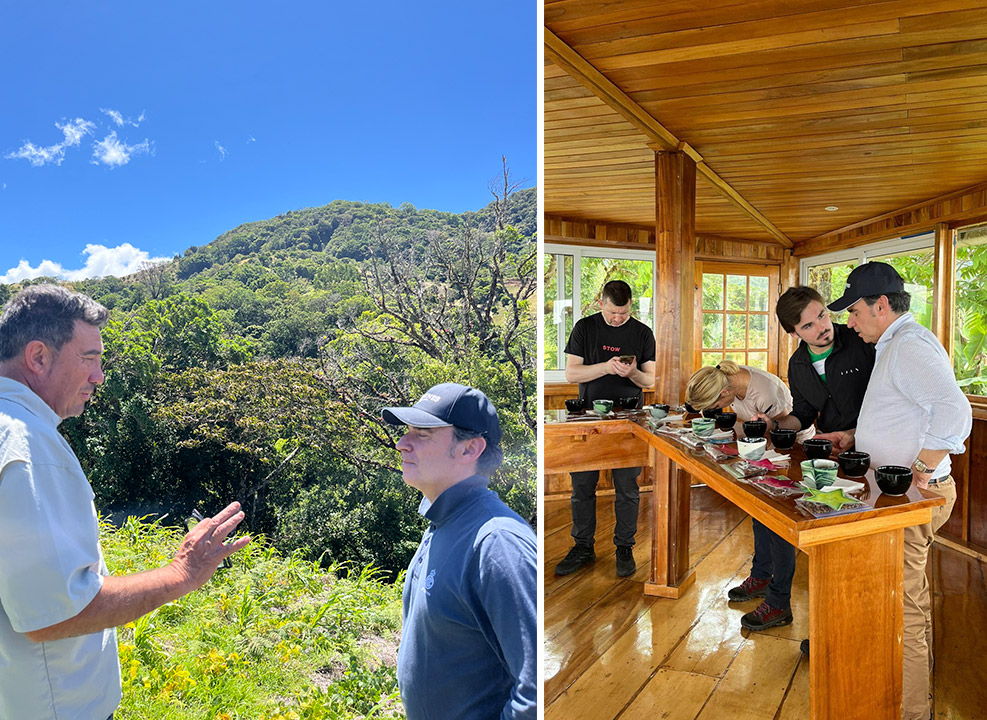
El punto de inflexión
The change came in the 1990s. In 1997, the Speciality Coffee Association of Panama (SCAP) was established, and its founding members committed to replanting their estates, prioritising quality over yield.
Training and sensory knowledge also took on a central role: a better understanding of cupping enabled producers to make more informed decisions about varieties, cultivation and processing.
In 1998, the Best of Panama competition was launched, and in 2001, the first international online auction took place. Panama then began to connect its finest coffees directly with buyers from around the world.
In 2004, a washed Gesha from Hacienda La Esmeralda fetched $21 per pound, an extraordinary price for that time. From then on, the variety became one of the main symbols of Panama’s new coffee identity.
This success also raises questions. The growth of speciality coffee has created significant opportunities for producers and communities, and the value achieved by certain lots has enabled investment in infrastructure and more sustainable agricultural practices.
However, the rise in demand and land values has also created tensions. In some areas, the arrival of international buyers and the growth of tourism have driven up land prices considerably, making it difficult for local producers and landowners to access land.
For this reason, ‘origin’ should not be understood solely as a geographical coordinate. It also involves understanding how the coffee is produced, who grows it, and what impact this activity has on the local area.
Panama’s terroir
Panama lies within the coffee belt, between the Tropics of Cancer and Capricorn. Its unique geography, straddling the Caribbean and the Pacific, creates a combination of altitude, humidity, temperature and wind that is particularly favourable for coffee cultivation.
In the northern mountains, the winds and humidity encourage the formation of ‘bajareque’, a mist that helps to lower the temperature on the estates and slow down the ripening of the coffee cherries.
Slower ripening can lead to a higher concentration of sugars and contribute to the development of complex, sweet flavour profiles. Added to this are the forests, which act as a natural windbreak and help to maintain favourable conditions for the coffee plant.
The main coffee-growing regions
Around 80 per cent of the coffee grown in Panama is Arabica. Most of the production is concentrated in three regions of the province of Chiriquí: Boquete, Volcán and Renacimiento.
- Boquete: the best-known and most traditional region, with farms reaching altitudes of up to 2,300 metres.
- Volcán: an area of great agricultural wealth, characterised by volcanic soils and particularly favourable high-altitude conditions.
- Renacimiento: a more remote region that is difficult to access, with less infrastructure, but with exceptional terroir potential.
These areas are situated around volcanic regions and boast rich, fertile soils. The harvest usually takes place between December and March, although conditions vary depending on the estate and altitude.
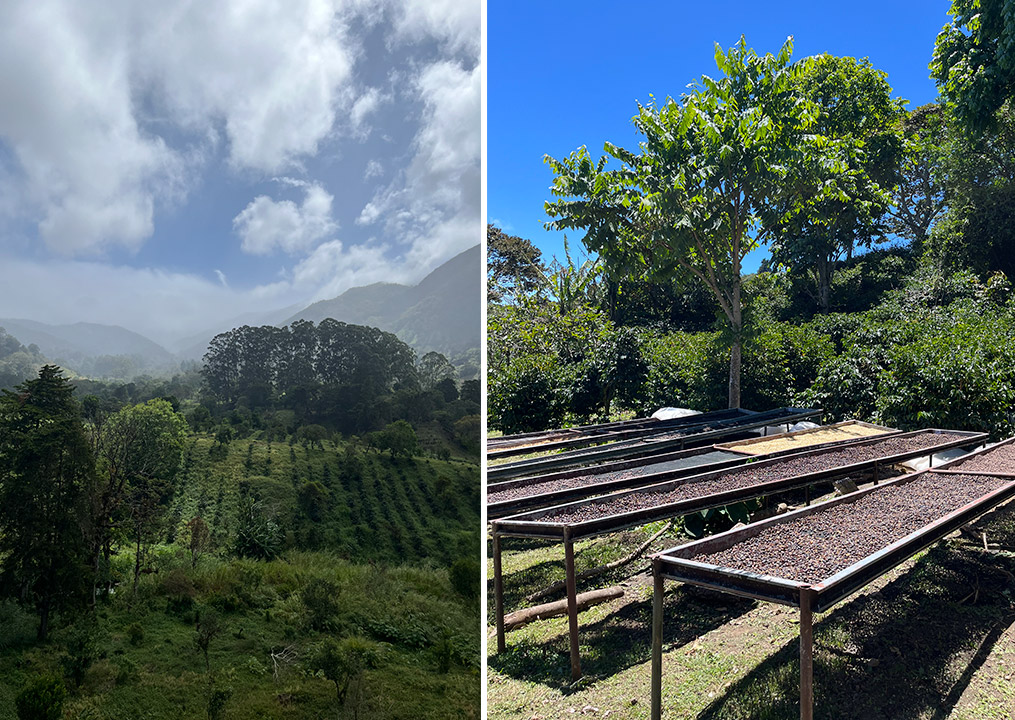
Processing: the other side of innovation
The recent history of Panamanian coffee cannot be explained solely in terms of variety or agronomy. Many producers have decided to go beyond the conventional formula, experimenting with processes capable of modifying, defining and enhancing the expression of a single coffee.
Anaerobic fermentation, extended fermentation and inoculation with specialised yeasts are all part of a culture of experimentation that has placed Panama at the centre of the conversation on coffee processing.
This constant quest is not driven solely by a desire to achieve high prices. For many producers, experimentation means gaining a deeper understanding of Panamanian coffee and finding new ways to express the character of a farm, a variety and a harvest year.
Panama does not need to produce large quantities to be significant
Its influence stems from something else: the ability to transform origin, precision and innovation into a way of understanding coffee. Here at Cafés El Magnífico, we invite you to enjoy Panamanian coffee as much as we do.